IHSS Appeal Process. Everything You Need To Know
In this post you will read about IHSS Appeal Process. Everything You Need To Know

As a mom to an autistic son who receives IHSS with Protective Supervision, I’m always learning how to navigate the system.
Between yearly renewals, paperwork, and evaluations, there’s always something new to prepare for. Personally, I haven’t had to appeal yet — but I know one day I might, and I want to be ready.
That’s why I’m writing this post — not just for myself, but for other parents too.
If you ever face a reduction or termination of hours, you don’t have to go through it alone. Let’s walk through the IHSS Appeal Process together so you know exactly what to expect.
Learn how to navigate the IHSS appeal process, request a fair hearing, and fight reductions in hours for your child.
So let’s dive in!
Disclaimer: This content is based on personal experience and is not legal advice. IHSS rules and interpretations may change and vary by case and county. For guidance specific to your situation, contact your local IHSS office or a qualified advocacy or legal resource.
1. Understanding The IHSS Fair Hearing Process

What Is A Fair Hearing?
A Fair Hearing is your chance to challenge IHSS decisions about your child’s hours. If your hours are reduced, denied, or terminated, you have the right to appeal.
“If you have applied for, have received, or are currently receiving benefits/services from an assistance program listed below and you receive a Notice of Action (NOA) from a County (…) denying or reducing your benefits, (…) you can ask for a State Hearing.” (Read More)
In-Home Supportive Services (IHSS) is an assistance program.
Why Would IHSS Hours Be Reduced Or Terminated?
- Reassessment of your child’s needs
- County claims that your child “improved”
- Misinterpretation of medical or behavioral reports
- Strict interpretation of eligibility criteria
Who Conducts The Hearing?
An Administrative Law Judge (ALJ) listens to both sides and makes the final decision.
Their role is “to resolve disputes of applicants and recipients of public benefit programs in an impartial, independent, fair, and timely manner, ensuring that due process is met in accordance with federal and state law.”
Timeline Overview:
- Notice of Action (NOA)
- Request for Fair Hearing
- Preparation
- Hearing Date
- Decision
2. First Steps When You Get the Notice

When that NOA lands in your mailbox:
Don’t panic — take a deep breath.
Read the Notice of Action carefully. Highlight the changes and reasons.
Mark your calendar: You have 10 days to request a hearing to keep your hours during the appeal (“aid paid pending”).
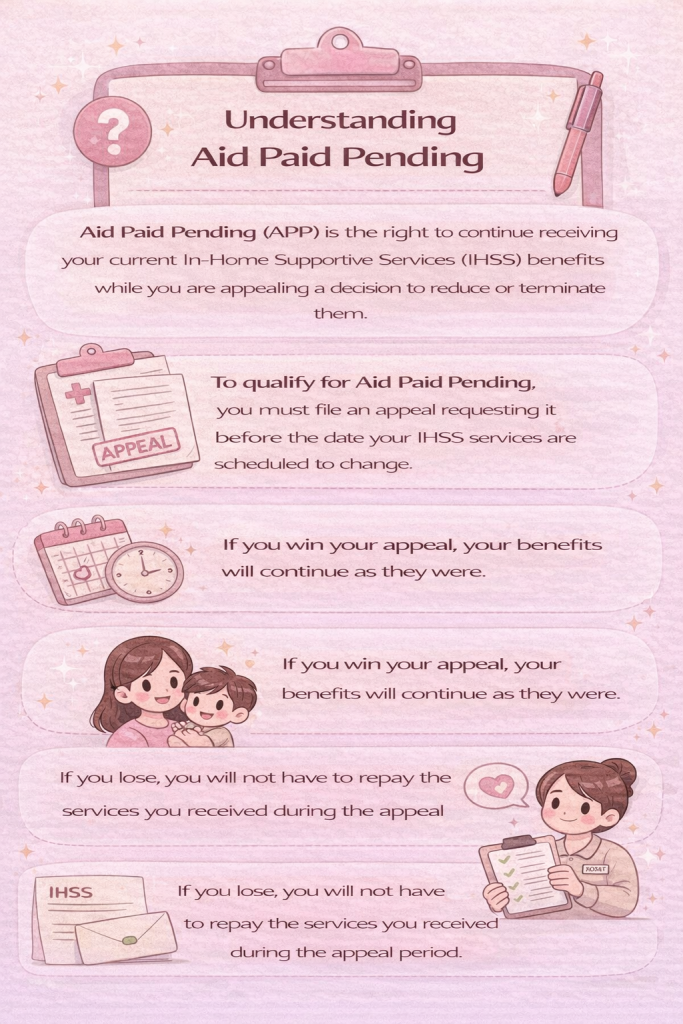
Aid Paid Pending (APP) is the right to continue receiving your current In-Home Supportive Services (IHSS) benefits while you are appealing a decision to reduce or terminate them. To qualify for Aid Paid Pending, you must file an appeal requesting it before the date your IHSS services are scheduled to change. If you win your appeal, your benefits will continue as they were. If you lose, you will not have to repay the services you received during the appeal period.
How To Request A Fair Hearing:

Online:
Request a hearing through CDSS. Click Here
Phone:
Call the number on your NOA.
Expedited Hearing by Phone:
Call the State Hearings Division toll free (800) 743-8525
Mail:
Send in the appeal form included with the notice.
“You may complete the “Request for State Hearing” on the back of the Notice of Action or put your request on a separate piece of paper. Please provide all requested information such as your full name, address, telephone number, the name of the county that took the action against you, the aid program(s) involved, and a detailed reason why you want a hearing.
It is always a good idea to keep a copy of your hearing request.
Submit your request to the county welfare department at the address shown on the Notice of action, by mail to:
California Department of Social Services
State Hearings Division
P.O. Box 944243, Mail Station 9-17-442
Sacramento, California 94244-2430″
Pro tip: Ask for your IHSS case file right away.
“You may contact your IHSS county worker or the county appeals worker assigned to your case before your hearing date to schedule an appointment to review your IHSS case file including any case worker notes which might be in your file.” (Read More)
Look for the Functional Index Rank and IHSS Hourly Task Guideline to see the amount of hours you were given according to the rank. I have a post on this, click here.
3. How to Prepare for the Hearing?

Gather Your Evidence:
I have a post with a step by step of what to give your caseworker: IHSS Autism. Everything You Need to Get Approved.
Here are some examples:
- Doctor’s letters (with specific, detailed risks)
- Regional Center reports or IPPs
- School IEPs
- ABA or behavioral reports
- Medication lists
- Incident logs (elopement, self-injury, aggression)
The county has to provide you with a written County Statement of Position before your hearing. Here you will find WHY they made the decision. Look it over and see if there are any mistakes on their part that need to be addressed.
Worksheets For More Data
The more information you provide the caseworker the better they can understand your situation and level of care required.
Here are some Worksheets to include:
- Worksheet 1: Request for Information Documenting Patient’s Functional Limitations
- Worksheet 2: IHSS Self-Assessment Worksheet
- Worksheet 3: IHSS Assessment Criteria Worksheet
These are all perfectly explained in Disability Rights California Posts “IHSS Fair Hearings Guide: How to Prepare for IHSS Terminations or Reductions in Hours“.
Write Your Parent Declaration:
Explain what daily life looks like with your child. Include real incidents that show why protective supervision is necessary.
I provided an Injury Log: Explained step by step here.
Witnesses:
Doctors, therapists, and caregivers can provide strong testimony.
Don’t be shy!
Make sure to explain why you need it and to focus on what the IHSS caseworker is interested in (why your child qualifies).
If you had to go to Urgent Care or Emergency Care, include those reports as well.
Photos/Videos:
When appropriate, they can show the risks in a powerful way.
4. Focus on Protective Supervision (If Applicable)

Protective supervision is to “safeguard against accident or hazard by observing and/or monitoring the behavior of non self-directing, confused, mentally impaired or mentally ill persons.” Read more
What it is: 24/7 monitoring to prevent injury due to mental impairment.
- Does my minor child not understand danger or when they might get hurt because of their mental impairment or mental illness?
- Will my minor child likely do things that could cause them to get hurt because of their mental
impairment or mental illness? - Does my minor child have the physical ability to put themselves in danger?
- Does my minor child need more supervision than another child the same age who is not mentally
impaired or mentally ill? - Do I have to supervise my minor child 24 hours a day because of their mental impairment or
mental illness? If yes, who helps me with this supervision?
What it isn’t: Medical care, babysitting, or general childcare.
Key criteria:
- Child is non-self-directing
- Child is at risk of injury
- Child needs constant monitoring
“Non self-directing means that because of their mental impairment or mental illness, and not their age, the minor child does not understand what is dangerous. Because a non self-directing minor child does not know what is dangerous, they are more likely to do things that are dangerous and risky that could cause them to get hurt.” (Read More)
How to prove it:
- Document real incidents like elopement, climbing, or self-harm.
- Include professional statements explaining the risks.
- Share parent testimony — your story is evidence.
5. What to Expect at the Hearing

Format: By phone or in person.
Who will be there:
- Administrative Law Judge (ALJ)
- County representative
- You (and an advocate, if you bring one)
What happens:
- Opening statements
- Evidence presentation
- Questioning and cross-examination
- Final statements
Tips:
- Stay calm and stick to the facts.
- Don’t be afraid to speak — you know your child best.
6. After the Hearing

Timeline: Expect a decision in 30–90 days.
- If you win: Hours stay the same or increase.
- If you lose: You can request a rehearing or you can appeal the decision by filing a Writ of Administrative Mandamus.
Consider connecting with advocacy groups like Disability Rights California if you need help.
7. Helpful Tips from One Parent to Another

- Keep documents organized in a binder with tabs.
- Start tracking behaviors daily — even now.
- Practice what you’ll say before the hearing.
- Connect with IHSS parent support groups.
Remember: You are your child’s strongest advocate.
8. Resources & Support

- Disability Rights California
- County IHSS Public Authority & advocacy groups
- Facebook Parent Support Groups (IHSS, Autism, Protective Supervision)
- Legal Aid Organizations
- Regional Center service coordinators
In this post you read about IHSS Appeal Process. Everything You Need To Know
To Summarize
This is an overwhelming process but you can win if you’re prepared.
Trust your instincts, gather your evidence, and never stop fighting for your child’s safety.
We’ve got this.
Other Posts You Will Love
- 7 Failproof Ways to Complete Your IHSS Timesheet
- What You Need To Know To Receive Maximum Hours For IHSS
- How To Claim IHSS Sick Leave. Tips You Need To Know.
- IHSS Autism. Everything You Need to Get Approved
- IHSS Renewal: What to Expect and How to Prepare
About The Author
Written by Belén, a former therapist, late-diagnosed neurodivergent woman, and stay-at-home mom to her autistic son. She creates thoughtful, practical content to support caregivers and families navigating hospital stays, disability, and neurodivergent life.
Learn the IHSS appeal process step by step, deadlines to know, what evidence to submit, and how to fight a denial or reduced hours.